
Bitcoin & Tokenisation
The typical Bitcoin four-year cycle is coming to an end in 2026
Halving, record high, crash, recovery – since 2012 Bitcoin has moved in a surprisingly steady rhythm. 2026 shows that the rhythm is still there, but it is losing strength.
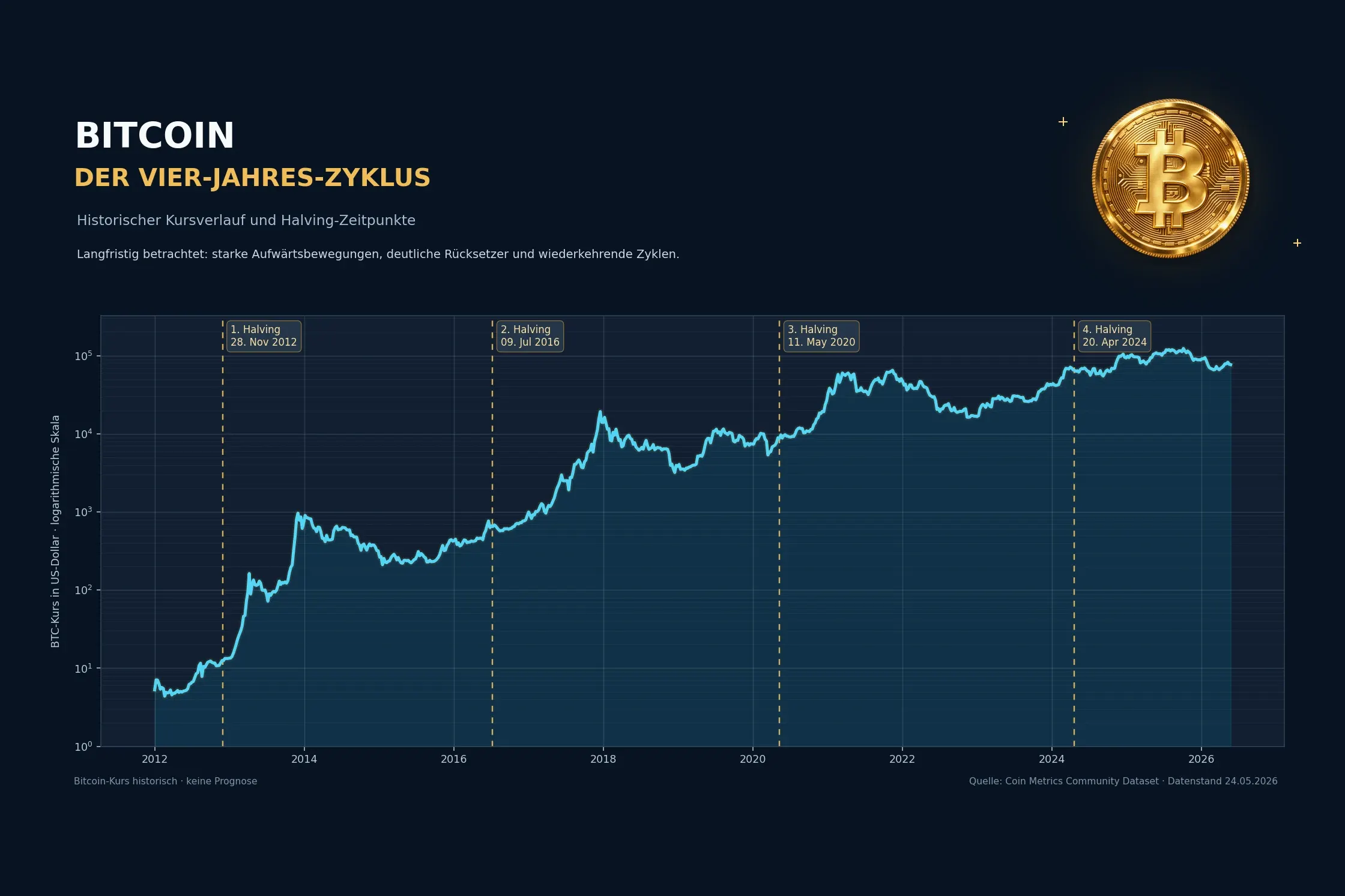
If you haven't followed Bitcoin closely for years, its sharp swings and long dry spells can be frustrating. Yet among insiders, the four-year cycle is one of the best-known patterns in Bitcoin. It depends on a number of factors that are often discussed in an emotional, overheated way. But a recurring pattern is not a reliable forecast. In this article we look at what points to the end of the typical cycle – and why you should keep other developments and risks in view as well.
Regardless of any cycle, there is a lot to suggest that Bitcoin will keep rising over the long term: its supply is mathematically capped at 21 million, while demand keeps growing. It is no coincidence that Bitcoin is called the digital gold of the future.
What is the Bitcoin four-year cycle?
Every 210,000 blocks – roughly every four years – the reward miners receive for new blocks is cut in half. This halving is written into Bitcoin's code. The last one took place in April 2024; the next is expected in 2028. Fewer new bitcoins with the same or rising demand: that is where the idea of a fixed rhythm came from.
In the past, the rhythm almost always played out the same way:
- Halving – the supply of new bitcoins drops.
- Bull market – about 12 to 18 months later, the price reaches a new all-time high.
- Crash – in the following year, the price falls by 75 to 85 percent.
- Bottoming out – the market slowly recovers until the next halving.
The numbers: same rhythm, smaller swings

Chart: Bitcoin price since 2012 (log scale, simplified) and the decline from each cycle high. Sources: bitcoin.com, Fortune; rounded values.
Looking at the four cycles shows two things at once. First, the timing still fits remarkably well. In the current cycle, too, the high came about 18 months after the halving – in October 2025 at around 126,000 US dollars. As usual, a weak year followed.
Second, the swings are getting smaller. From 2013 to 2015 Bitcoin fell by about 87 percent, in 2018 by 84 percent and in 2022 by 77 percent. This time the low came in June 2026 at around 58,000 US dollars – a drop of about 54 percent. In early November 2026, Bitcoin is trading at around 77,000 US dollars, just under 40 percent below its record.
What points to the end of the typical cycle
- The halving carries less weight. More than 95 percent of all bitcoins have already been mined, and new annual supply is below one percent. Each further halving takes less and less supply off the market.
- Large investors buy differently. Through spot ETFs, money from asset managers, pension funds and companies flows into Bitcoin. These buyers plan in decades, not in halving intervals.
- The rules have already been broken. Bitcoin hit a record high in March 2024, before the halving. And 2025 was the first post-halving year to close in the red.
- Less euphoria. Measures of overheating were clearly lower at the 2025 high than in earlier cycles. Where there is less excess, the crash is smaller too.
- Monetary policy matters more. Many analysts now see Bitcoin tied more closely to global liquidity and central bank rate decisions than to the halving calendar.
What speaks against it
It isn't that clear-cut. At the end of 2025, Bitwise and Grayscale declared the cycle over and expected new records in 2026. That hasn't happened so far. Fidelity, on the other hand, saw 2026 as an "off year" in line with the usual pattern – and came closer to reality. BitMEX Research also points out that the cycle has often been declared dead, always in exactly the phase in which it would predict sideways or falling prices anyway.
The most honest answer is therefore: the four-year cycle won't disappear overnight – it is flattening out. It still works as a rough map, but no longer as a timetable for planning entries and exits to the month.
What this means for you
- Don't rely on a calendar pattern. Betting solely on "the next high in 2029" means betting on a rule that is losing strength.
- Still expect significant swings. Even a 54 percent decline has to be sat through first.
- Watch the new drivers: ETF flows, interest rates, regulation and the behaviour of large holders.
- Only invest money you can do without in the long term, and diversify your assets.
Frequently asked questions
When is the next Bitcoin halving?
The next halving is expected in spring 2028. The exact date depends on how quickly new blocks are produced.
Is the Bitcoin four-year cycle over in 2026?
Not quite. The timing still fits in the current cycle, but the price swings are much smaller. Many analysts therefore speak of a weakening cycle rather than its end.
How far has Bitcoin fallen since its 2025 high?
From its record of around 126,000 US dollars in October 2025, Bitcoin fell to about 58,000 US dollars by June 2026 – a decline of roughly 54 percent. In early November 2026 the price was around 77,000 US dollars.
Conclusion
The four-year cycle shaped Bitcoin for more than a decade. Today, large investors, ETFs and monetary policy increasingly drive the price. The pattern is fading – and that is exactly why it pays to take a closer look at what lies behind Bitcoin.
I'm happy to help you understand Bitcoin, Bitcoin mining and tokenisation better. Through my network I have access to some interesting projects, which I can introduce to you in a conversation – one example is the SmartIT Token (SIT).
I'll support you from assessing your personal situation through to making a decision and putting it into practice. To do this, I connect you with selected partners.
Note: This article is for information only and does not constitute investment advice. Bitcoin and crypto investments are subject to high volatility, up to and including total loss.

