
IAB projects
Composting as an IAB project: saving on tax without the electricity market
Almost all IAB investors are backing electricity. A compost bin generates high returns from a completely different market – and still reduces your tax bill.
Anyone who has taken part in IAB projects in the past has almost always invested in electricity: solar panels, battery storage systems, and perhaps a stake in a wind turbine. It works, but there’s a catch. All these projects are tied to the same market, which is regulated by the government. If electricity prices fall or the rules for feeding electricity into the grid change, your entire IAB portfolio is affected all at once.
One area that hardly anyone thinks about is the recycling of organic waste. Specifically: mobile composting units that process food scraps and other organic waste right where they are produced. This method of disposal is not only significantly cheaper, but also odourless and eliminates the need for expensive refrigeration of organic waste. I’ll introduce you to the model here and show you what to look out for.
The problem: tonnes of food waste every day
Hotels, commercial kitchens, hospitals, canteens, restaurants, supermarkets and food manufacturers produce large quantities of organic waste every day. At present, this waste is usually collected, stored in a cool place and collected several times a week. This costs money, produces odours, takes up space and involves transport. The costs associated with this are rising sharply.
For many businesses, it is therefore an attractive option to process waste directly on site. This is precisely where specialised composters come in.
How a portable composter works
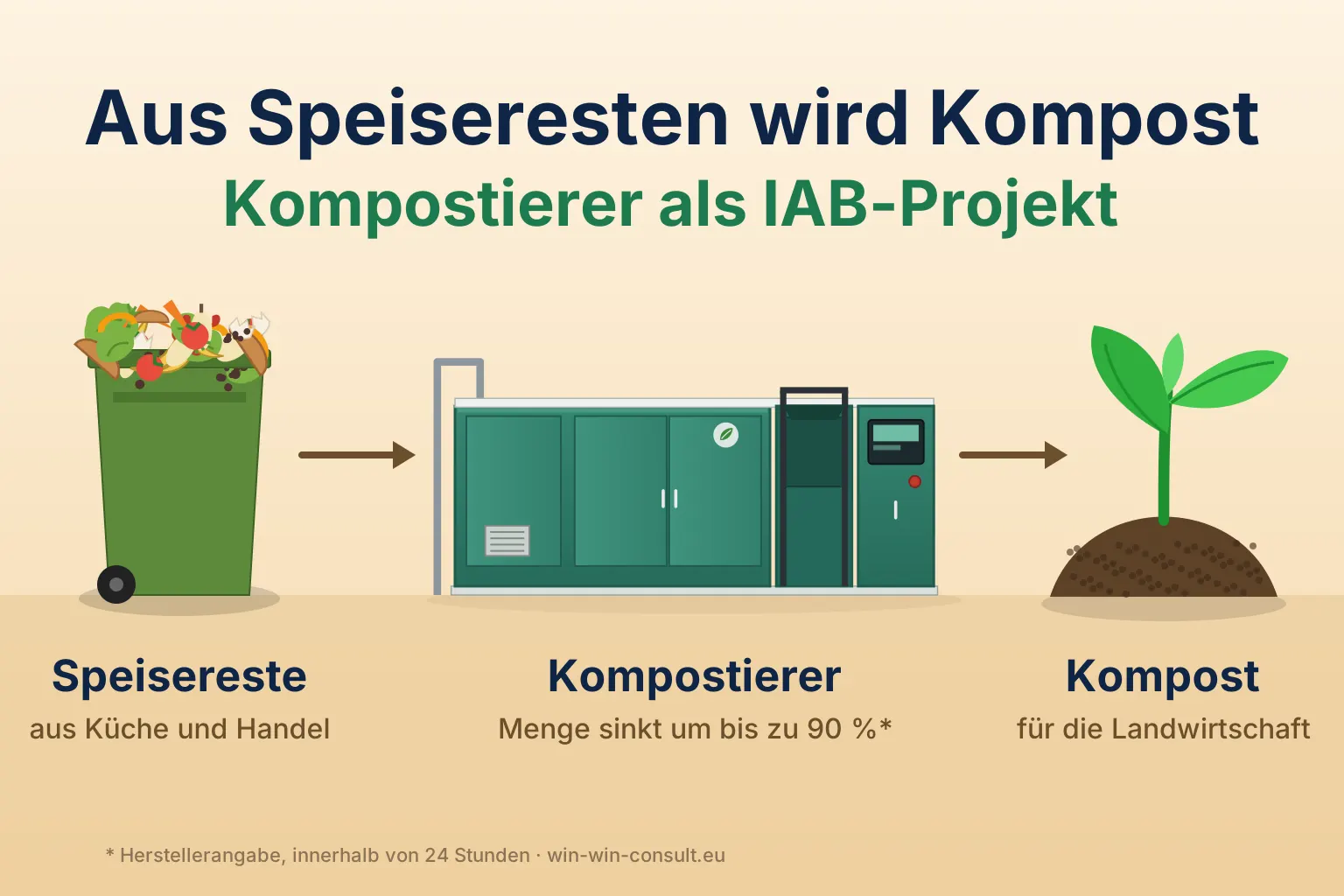
The unit is located at the premises of the business that generates the waste. Food scraps and kitchen waste are fed into the top. Micro-organisms break down the material without it first needing to be shredded or heated. According to one manufacturer, this reduces the volume by up to 90 per cent within 24 hours. What remains is a dry, largely odourless substrate that can be reused as compost or fertiliser.
The systems are available in various sizes, ranging from small units for the kebab shop round the corner to large-scale systems for the disposal of organic waste from local authorities or cities. They require little energy, no planning permission and no foundations. This makes them a movable asset, which is a crucial factor for the IAB.
Why this is of interest as an IAB project
When considering an IAB investment, it is always important to analyse the investment market and its future prospects. And it is precisely here that there is a huge demand in Europe, as in other countries, for the efficient disposal of organic waste over the coming decades. This market is also highly resilient to crises, as food is always in demand. These are ideal conditions for a long-term investment.
With this model, you purchase one or more systems and can use them to tailor the purchase price to closely match your required IAB level. The day-to-day operation – including installation, maintenance and billing – is handled by a full-service operator. The plants are leased to businesses with high volumes of organic waste, and you receive attractive monthly rental income.
What I like about this model:
- Independent of the electricity market. Revenue depends on the volume of waste generated by the catering and retail sectors, not on electricity prices or government subsidies. The market is resilient to economic downturns, as food is always in demand.
- No need to wait for the mains connection. Anyone familiar with PV investors knows just how much time, money and stress this can involve. A compost bin is delivered, set up and ready to go.
- Smaller amounts are possible. Depending on the system, the initial investment and unit cost are significantly lower than for a large PV system.
- A meaningful and thoroughly sustainable cause. Fewer journeys, less waste; compost is returned to the agricultural sector.
Suppliers of such models promise rental returns of up to 12 per cent a year on ten-year leases. These figures are taken from quotations and are not guaranteed. How reliable they are depends on the lease agreement, the quality of the composters and the creditworthiness of the operator and the tenant.
A calculation example
A single management consultant has a taxable income of €180,000. He plans to purchase composting plants for €200,000 next year and is setting aside an IAB of €100,000 this year for this purpose.
- Income tax excluding IAB: €64,464
- Income tax using the IAB method: €22,464
- Tax savings in the first year: €42,000
Calculated on the basis of the 2026 basic rate, excluding the solidarity surcharge and church tax.
In the year of acquisition, he may also claim a special depreciation allowance of up to 40 per cent of the remaining acquisition cost – in this case, up to €40,000. On top of this comes the standard depreciation over the useful life of the assets.
As always, the IAB defers part of the tax to later years, as the rental income is subject to tax. The benefit arises because you claim the deduction today at your current high tax rate, whilst the income is often taxed later – for example, in retirement – at a lower rate. If you continue to have a high taxable income, you can make use of the IAB several times in the future, thereby permanently reducing your taxable income.
What you need to bear in mind
As I’ve said in my other posts: making an investment purely for tax reasons has never been a good decision. This is particularly true of compost bins, as this model is still relatively unknown.
- Commercial design. Simply letting out a single item is often not considered a business for tax purposes, and without income from profits, there is no IAB. Ask the provider to show you how the model is structured as a business, and have it checked by your tax adviser.
- Who pays the rent? Check who the tenancy agreement is with, how long it runs for and what happens if a tenant defaults. A ‘guaranteed’ return is only as good as the person guaranteeing it.
- The provider’s registered office and credit rating. Check where the company is based, how long it has been in business, and whether there are any reference projects you can take a look at.
- What happens once the tenancy period is over? Clarify what will happen to the plant once the contract expires: renewal, buy-back, sale or disposal.
- The investment must go ahead. You must redeem the IAB within three years of purchase. Otherwise, it will be cancelled with retroactive effect and the tax will be reclaimed with interest.
- The investment must be worthwhile. Without a genuine intention to make a profit, the activity risks being classified as a hobby, in which case the tax benefit is lost.
My timetable for you
- Check how much IAB volume you can realistically utilise this year.
- Think about what proportion you’d like to diversify outside the electricity market.
- Request the contractual documents: sales contract, tenancy agreement, operating agreement.
- Have your tax adviser check the business structure and the figures.
- Include the IAB in your tax return. You can do this retrospectively, provided the return for that year has not yet been submitted.
Frequently Asked Questions
Can I set up an IAB for a compost bin? In principle, yes, because a mobile composting plant is a movable asset. The key factor is that it is used in a business that generates a profit.
Is letting the property through the IAB harmful? Not since 2020. Even long-term letting to third parties is regarded as business use.
How much is the tax saving? The IAB amounts to up to 50 per cent of the planned investment. With a tax rate of 42 per cent, you therefore save around 21 per cent of the investment amount in the first year. In the year of purchase, you can claim a further 40 per cent special depreciation allowance on the remaining acquisition costs.
Why not just install another solar panel system? Because this means you’re concentrating your risk even further on the electricity market – in technical terms, this is known as ‘concentration risk’. A composting plant diversifies your IAB portfolio into a completely different market.
Conclusion
The composter is no substitute for solar power, but it is a useful addition. It generates income from a market that has nothing to do with electricity prices, and it solves a real problem for many businesses. As with any IAB project, the contract, the partners and sound tax planning determine whether it is worthwhile.
I’ve also seen this model in a Video on my YouTube channel explained.
I’ll guide you through the process, from assessing your personal situation right through to decision-making and implementation. To this end, I’ll put you in touch with selected partners. Tax advice should be sought from your tax adviser. You can find out more about the IAB in my free e-book.
Warm regards
Michael Rehberger
This article is for general information purposes only and does not constitute tax or legal advice. Last updated: October 2026.

