
Severance pay & occupational pension
Withdrawing your company pension: How to keep more of your capital
A pension or a lump sum? Anyone considering taking their occupational pension as a lump sum should work out the figures carefully beforehand.
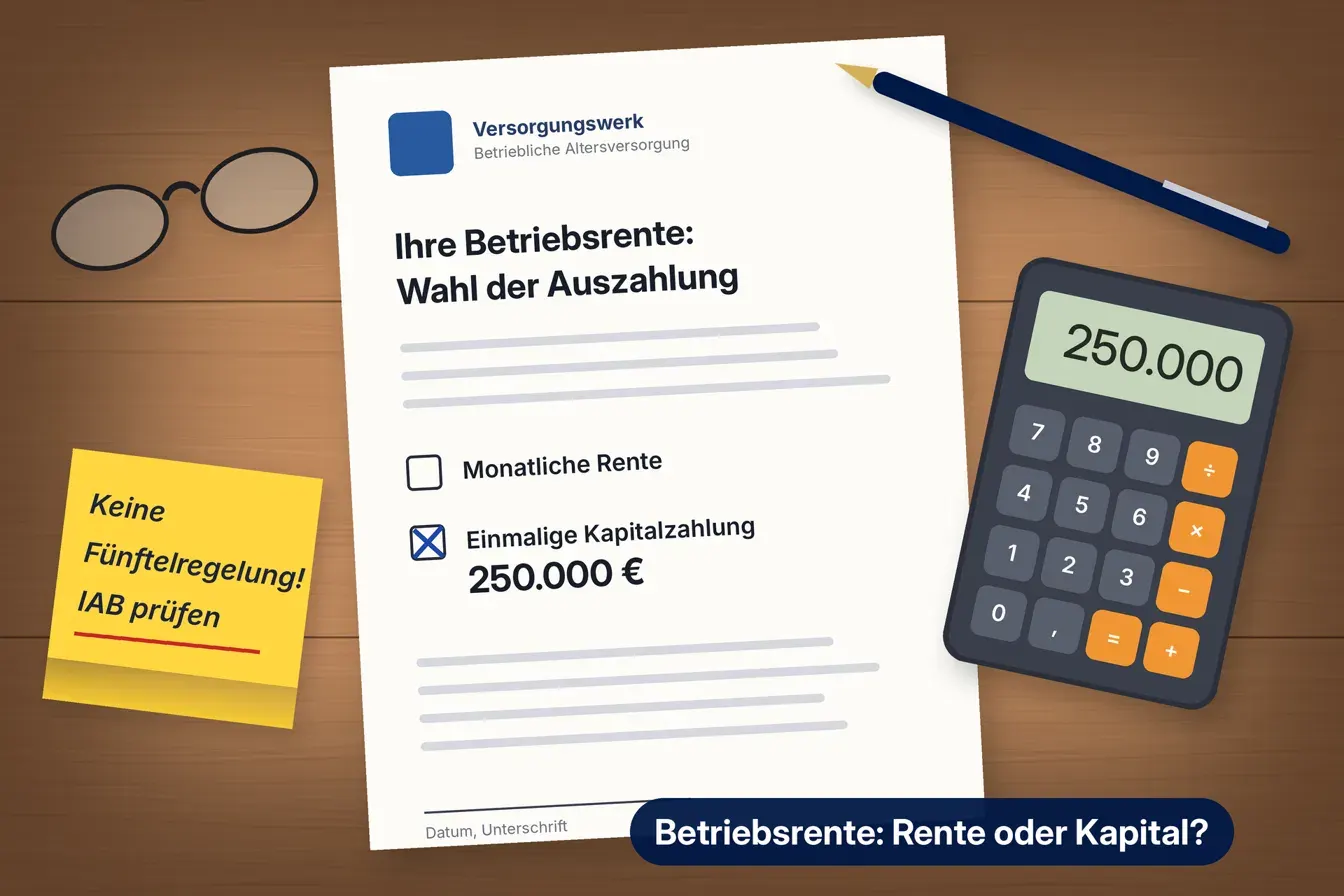
Shortly before retirement, many people receive a letter from their insurer: you can choose to receive your occupational pension as a monthly pension or as a lump sum. The lump sum is tempting. You have the money straight away, can spend it as you wish, and don’t have to hope that you’ll live long enough for the pension to be worthwhile.
What this letter usually doesn’t mention is how much of it goes to the tax office and your health insurance provider. With a payout of €250,000, that can quickly add up to around €150,000. Here, I’ll show you why that’s the case and how you can keep a large portion of it.
How company pension payouts are taxed
The key factor is how your occupational pension was accrued. You can find this information in your contract documents or by asking your insurer:
- Direct insurance, pension scheme or pension fund with tax-free contributions (usually deferred compensation from 2005 onwards): The entire payout is taxable at your personal tax rate in the year of the payout. This is the most common scenario today.
- Old direct insurance policies taken out before 2005 with contributions taxed at a flat rate: The payout is usually tax-free if the policy meets the conditions that applied at the time, such as a twelve-year term. Congratulations – in that case, this article is hardly relevant to you.
- Direct approval or support fund (promised by the employer): taxable, but the ‘fifths rule’ may still apply in this case.
Contracts are often a mix of different types. In that case, the insurer must split the payout and provide you with a certificate to that effect.
The ‘one-fifth rule’ has largely been abolished
Many people assume that a one-off payment will be taxed at a reduced rate, just like a severance payment. In the case of direct insurance, pension schemes and pension funds, this is no longer the case in most instances.
On 30 October 2025, the Federal Fiscal Court ruled (X R 25/23 and X R 28/23) that if your contract allows you to choose freely between an annuity and a lump sum, the payout is not ‘extraordinary’. In that case, the ‘one-fifth rule’ does not apply. And it is precisely this right of choice that is included in almost all contracts. You can find a good summary of the judgement at Deloitte.
In other words, the entire amount will be added to your other income in a year’s time. With €250,000, you’ll be taxed at the top rate of 42 per cent – and on part of it, as much as 45 per cent.
The second pitfall: ten years’ health insurance
If, as a pensioner, you are covered by statutory compulsory insurance, the payment counts as a pension benefit. The health insurance fund spreads this out mathematically over 120 months and charges contributions on it for ten years – at the full rate, without the employer’s contribution. For 2026, a Tax-free allowance of €197.75 per month.
Take €250,000 as an example: that works out at around €2,083 a month. After the tax-free allowance has been deducted, you’ll pay around €330 a month for health insurance and €75 a month for long-term care insurance. Over ten years, that amounts to around €48,600.
This is almost impossible to avoid, but you should be aware of it. There is one exception: if you have continued the policy privately as the policyholder after your employment ended, the portion derived from your own contributions is contribution-free. Those with private health insurance do not pay any contributions on the payout.
A pension or a lump sum?
The monthly pension is also subject to tax and social security contributions, but these are spread over many years and are usually taxed at a lower rate. On the other hand, the money is tied up and is often lost in the event of death.
Capital gives you freedom: you can invest it, pass it on to your heirs or use it for larger projects. The cost is the high tax payable in the year of withdrawal. And it is precisely this cost that you can reduce.
The lever: investment allowance (IAB)
With the IAB, you can claim up to 50 per cent of a planned investment as a business expense in the year prior to the purchase. To do this, you need to run your own small business. You’ll qualify as soon as you invest in an IAB-eligible project, such as a commercial solar panel system, a battery storage system, a composting facility or a tiny house for letting.
The loss from this business will be offset against your other income in the same year, including the payment from your occupational pension.
An example: A pensioner has a taxable income of €30,000 in addition to her state pension. In the first year of her retirement, she takes a lump-sum payment of €250,000 from her private pension scheme. The additional income tax is payable only on the lump-sum payment:
- Excluding tax planning: €102,312
- With an IAB of €125,000 (investment of €250,000): €49,747
- With an IAB of €200,000 (investment of €400,000): €18,247
Calculated on the basis of the 2026 basic rate, excluding the solidarity surcharge and church tax.
It is not possible to receive more than €200,000 in IAB funding per business; this is stipulated by Section 7g of the Income Tax Act (EStG) fixed. In the case of very large payouts, there is therefore a residual amount which is taxed at the standard rate. In the example, the pensioner still saves a good €84,000 in tax in the year of the payout.
Just so there’s no misunderstanding: the tax doesn’t simply disappear. It is carried forward to subsequent years, when the investment generates returns and there is less depreciation left to claim. In retirement, however, your tax rate will usually be well below 42 per cent. And the money you’re not paying to the tax office today is working for you.
Incidentally, the IAB does not reduce the health insurance contributions on the benefit payment. These are based on the benefit payment itself, not on your income.
What you need to bear in mind
As I’ve said in my other posts: making an investment purely for tax reasons has never been a good decision.
- Deadline for exercising the capital option: Many contracts require you to decide on the lump sum payment several months before your pension starts. Have a look at your documents early on.
- The same year: The IAB and the payment must fall within the same tax year. You can also claim the IAB retrospectively, provided that the tax return for the year in which the payment was made has not yet been submitted.
- The investment must go ahead. You must claim the IAB within three years. Otherwise, it will be cancelled with retroactive effect and the tax, plus interest, will be claimed retrospectively.
- The project must be profitable. Without a genuine intention to make a profit, there is a risk of it being classified as a hobby. In that case, the benefit is lost.
- Future earnings and health insurance: As a pensioner covered by compulsory insurance, any profits from your business may be subject to contributions at a later date. Make sure you check this beforehand.
- Liquidity: Make sure you have sufficient reserves. An IAB project ties up capital for many years.
My timetable for you
- Check how your contract has been funded and whether the payout is subject to tax.
- Check the deadline for the capital option.
- If possible, time the payout to coincide with a year when you have little other income – often the first full year of your pension.
- Work out both options: a pension versus a lump sum, with and without IAB.
- Choose a vetted project and have your tax adviser oversee the whole process.
Frequently Asked Questions
Is the payout from my direct insurance policy tax-free? This applies only to old contracts dating from before 2005 with contributions taxed at a flat rate. More recent contracts based on deferred compensation are fully taxable.
Does the one-fifth rule apply to my occupational pension? This is not usually the case with direct insurance, pension schemes and pension funds offering a lump-sum option. It may apply in the case of direct pension commitments and support funds.
Do I have to pay health insurance contributions on the one-off payment? As a pensioner covered by statutory compulsory insurance, yes – for ten years, at one-hundred-and-twentieth of the total amount per month, less the tax-free allowance.
As a pensioner, can I use an IAB at all? Yes. The key factor is having your own small business, such as a commercial solar panel installation. Age is not a factor.
My company pension has already been paid out. Is it too late? Not necessarily. As long as you haven’t yet submitted your tax return for the year in which the payment was made, you can still claim the IAB on that return. So, if the payment was made in 2024 or 2025, it’s worth having a look.
Conclusion
Since the Federal Fiscal Court (BFH) ruling, the lump-sum payment from a company pension scheme has become more expensive than many people realise. Without proper planning, over €100,000 of a €250,000 payment can quickly go to the tax authorities, on top of which there are ten years’ worth of health insurance contributions. With a well-vetted IAB scheme, the tax liability in the year of payment can be significantly reduced.
I’ll guide you through the process, from assessing your personal situation right through to making a decision and putting it into action. To this end, I’ll put you in touch with selected partners.
Tax assessment is best left to your tax adviser. Please do get in touch, ideally before you exercise your capital option. You can find more background information in my free e-book on the IAB and in my Contribution towards the severance payment.
This article is for general information purposes only and does not constitute tax or legal advice. Last updated: October 2026.

